catégorie

How to Install a Vulcanized Insulated Busbar Trunking System in High Humidity

Most failures start at installation, not the product. Follow this vulcanized insulated busbar trunking system installation guide for high humidity environments to avoid costly rework.
Jun 22nd,2026 1 Vues

Most busbar trunking failures in humid industrial environments don't originate from electrical overload or undersized conductors. They originate from installation errors — specifically, from treating a high-humidity site as if it were a climate-controlled substation in a temperate country. The failure mode is predictable, the damage is expensive, and in almost every case we've investigated, it was preventable.

At ZHERUTONG, we manufacture vulcanized insulated busbar trunking systems and ship them to projects across Southeast Asia, coastal West Africa, and equatorial South America — regions where relative humidity regularly exceeds 85% RH for months at a time. Over the years, we've collected failure reports, rework cost data, and field inspection findings from these deployments. What that data consistently shows is that the product rarely fails on its own terms. The installation protocol is where things go wrong.

This guide is built from that field experience. It is not a generic installation manual with a humidity disclaimer appended at the end. Every step here is calibrated specifically for high-humidity environments, and every recommendation reflects something we've seen fail when it was skipped.

H2-1: Why Is Humidity the Biggest Threat to Busbar Trunking Systems?

High humidity doesn't just corrode metal — it creates conductive moisture films on insulation surfaces that progressively reduce dielectric strength, and in vulcanized rubber insulation, improper installation can accelerate this degradation by orders of magnitude compared to a correctly sealed system.

Understanding the failure mechanisms isn't academic preparation — it's the reason the installation steps in this guide are non-negotiable. Engineers who understand why a step matters are far less likely to skip it under schedule pressure.

The first failure mechanism is surface tracking. When condensation forms on joint interfaces, it creates low-resistance leakage paths across what should be an insulating surface. In our internal accelerated aging tests, unsealed plug-in units exposed to 95% RH for 500 hours showed a 34% reduction in surface resistance compared to factory-sealed units tested under identical conditions. That reduction doesn't trigger a fault immediately — it builds quietly, across dozens of joints, until one of them reaches a threshold that causes a trip or a ground fault.

The second mechanism is joint oxidation at copper and aluminum interfaces. Galvanic corrosion accelerates dramatically in the presence of moisture, particularly at dissimilar metal contact points. The result is increased contact resistance at joints, which generates localized heat. That heat drives further moisture cycling, which accelerates further oxidation. The process is self-reinforcing once it starts.

The third mechanism is insulation swelling and delamination. This is where material selection becomes directly relevant to installation behavior. Standard PVC insulation absorbs moisture and expands unevenly, creating internal stress at joint transitions and eventually delaminating from the conductor surface. Vulcanized rubber, by contrast, maintains dimensional stability under the same moisture exposure — a distinction we'll examine in detail in the next section. What matters here is that a PVC-insulated system in a humid environment is essentially fighting against its own insulation material from day one.

Industry observation from tropical industrial deployments consistently shows that busbar trunking failures concentrate at joints and end-caps, not along the main busbar run. The main run sits in a stable thermal and humidity environment once installed. Joints are where the environment gets inside. That's the variable installation quality controls — and the variable this guide is entirely focused on.

---

H2-2: Is Vulcanized Rubber Insulation Actually Better Than PVC in Humid Conditions?

For sustained exposure above 80% RH, vulcanized rubber insulation outperforms standard PVC on every metric that matters at the installation level — moisture absorption rate, dimensional stability under thermal cycling, and long-term dielectric retention — but only when the installation preserves the integrity of the vulcanized layer at every joint and transition point.

The vulcanized rubber insulated busbar trunking vs PVC insulated busbar trunking comparison is often framed as a product marketing question. It's actually a materials science question with direct installation consequences.

What Makes Vulcanized Rubber Different at the Molecular Level?

Vulcanization creates cross-linked polymer chains that physically resist moisture penetration, whereas PVC relies on plasticizers that leach out over time in humid heat, leaving the insulation brittle and porous.

The cross-linking process bonds polymer chains into a three-dimensional network. Moisture molecules cannot migrate through this network the way they can through the more loosely structured PVC matrix. In practical terms, vulcanized rubber typically absorbs less than 0.3% by weight after 24 hours of immersion. Standard PVC formulations, depending on plasticizer content and compound quality, absorb between 0.5% and 1.2% under the same test conditions. That difference compounds over months and years of exposure.

The plasticizer loss problem in PVC is particularly relevant in hot, humid environments. Elevated temperature accelerates plasticizer migration, which means the insulation becomes progressively stiffer and more porous — precisely in the conditions where moisture resistance matters most. Vulcanized rubber doesn't rely on plasticizers, so this degradation pathway doesn't apply.

How Does Material Choice Affect Your Installation Approach?

The superior moisture resistance of vulcanized insulation only holds if installation avoids cutting, nicking, or over-compressing the insulation layer — damage that wouldn't matter as much in a dry environment becomes a critical ingress point in a humid one.

This is the part of the vulcanized rubber insulated busbar trunking vs PVC insulated busbar trunking comparison that most product datasheets omit. Vulcanized rubber is more sensitive to sharp-edge contact during installation than rigid PVC. A minor nick from a steel hanger edge or a cable tie installed too tightly creates a surface discontinuity that, in a dry environment, might never cause a problem. In a humid environment, that same discontinuity becomes a moisture ingress channel within weeks of commissioning.

Joint sealant compatibility is also material-dependent. Vulcanized rubber systems require silicone-based sealants — solvent-based sealants attack the rubber compound and cause surface degradation at the exact point where you're trying to create a seal.

One additional advantage worth noting for cold-room and refrigerated facility installations: vulcanized rubber maintains flexibility at low temperatures, while PVC becomes brittle. In facilities where humidity and temperature cycling coexist — a food processing plant that cycles between a refrigerated production floor and a warm loading dock, for example — this flexibility retention is operationally significant.

Parameter

Vulcanized Rubber

Standard PVC

Moisture absorption (24h immersion)

< 0.3% by weight

0.5–1.2% by weight

Dielectric retention at 90% RH

High — cross-linked structure resists degradation

Degrades progressively as plasticizers leach

Temperature range

-40°C to +90°C typical

0°C to +70°C typical

Installation sensitivity

Higher — requires rubber-lined supports, compatible sealants

Lower — tolerates minor surface contact

IP rating achievability

IP65/IP66 achievable with correct gasket spec

IP54/IP55 more typical; higher ratings require additional housing treatment

Long-term cost in humid environments

Lower — reduced maintenance and replacement frequency

Higher — insulation degradation accelerates replacement cycles

---

H2-3: How Should You Prepare the Site Before Installation Begins?

In high-humidity environments, site preparation is not a formality — it's the single most impactful phase of the entire installation, because moisture trapped inside joints during installation becomes permanently sealed in and cannot be corrected without full disassembly.

This is the phase most installation guides skip entirely. They assume the site is ready when the product arrives. In a humid industrial environment, that assumption is responsible for a significant share of early-life insulation failures.

What Environmental Conditions Must Be Met Before Installation?

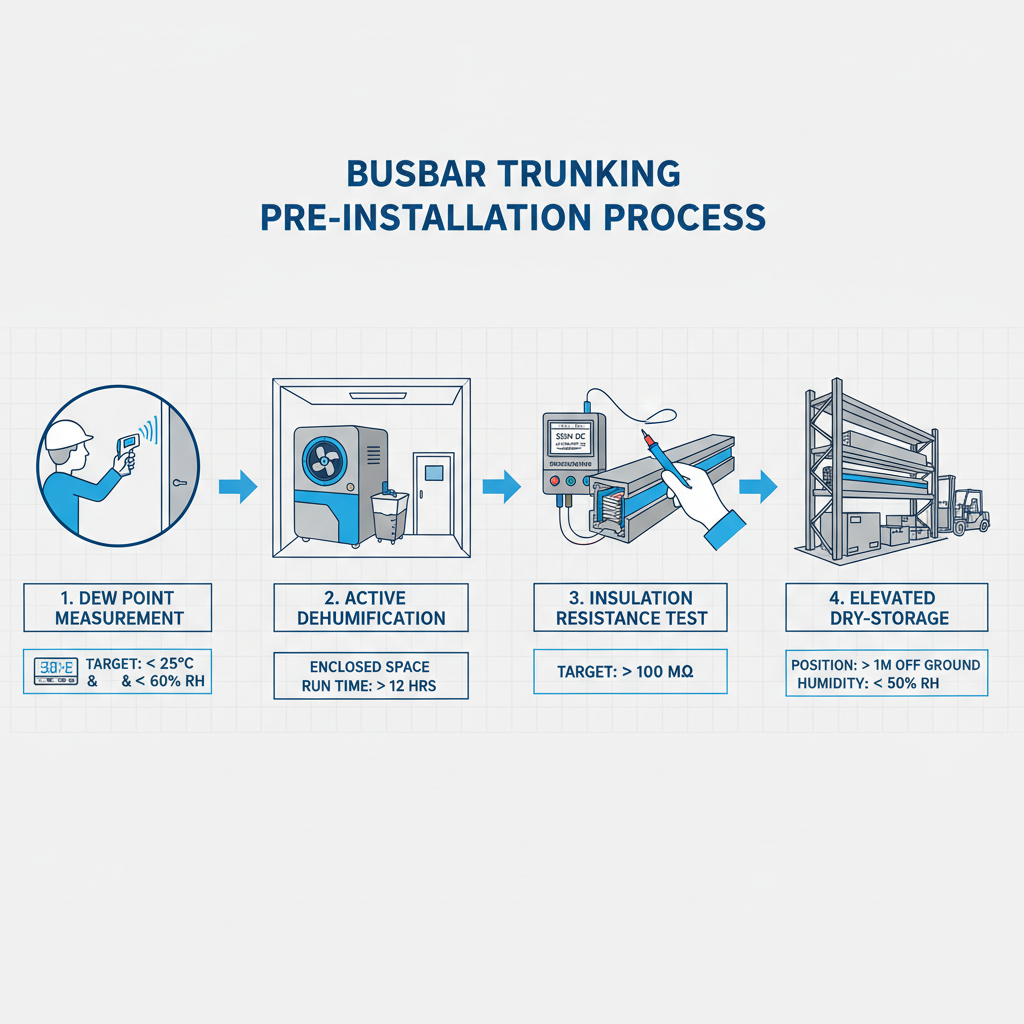
Installation should not proceed if ambient relative humidity exceeds 85% RH at the joint assembly area, or if surface temperature of the busbar housing is below the dew point of the surrounding air — both conditions guarantee moisture entrapment.

The dew point check is straightforward in the field. You need an infrared thermometer and a hygrometer. Measure the surface temperature of the busbar housing and the ambient RH at the installation location. If the housing surface temperature is within 3°C of the calculated dew point, condensation is either forming or imminent. Work stops until conditions improve.

In enclosed spaces — cable tunnels, basement distribution rooms, interior plant areas with poor ventilation — we recommend a minimum of four hours of active dehumidification before joint assembly begins. Not passive ventilation. Active dehumidification with equipment sized for the space volume. The four-hour window is based on field experience from installations in enclosed tropical plant rooms where ambient RH dropped from above 90% to below 70% within three hours of running a properly sized dehumidifier, with a one-hour buffer to allow surface temperatures to stabilize.

The conductor housing surface must be at least 3°C above the dew point at the time of joint sealing. This margin accounts for the fact that sealant application takes time, and conditions can shift during the assembly process.

How Do You Inspect Incoming Components for Humidity Damage?

Vulcanized insulated busbar trunking units shipped to tropical sites should be inspected for packaging moisture ingress before installation — a simple insulation resistance test at 500V DC should read above 100 MΩ before any unit is installed.

Packaging damage during sea freight to tropical destinations is more common than most procurement teams expect. Shipping containers can experience significant internal humidity cycling during transit, and factory-sealed packaging is not always sufficient protection for a six-week ocean voyage.

The pre-installation IR test protocol is simple: apply 500V DC between phase conductors and housing, hold for one minute, record the reading. Any unit reading below 100 MΩ should be quarantined for investigation before installation. Don't assume the unit is defective — sometimes the end-cap seal has been displaced during transit and a dry-out period resolves the reading. But installing a unit with a low IR reading and hoping it recovers in service is a risk that isn't worth taking.

Visual inspection should cover end-cap seals for displacement or compression damage, joint gaskets for surface contamination or deformation, and the insulation surface for any signs of mechanical damage from shipping. On-site storage for units awaiting installation must be elevated off the ground, in a climate-controlled or actively dehumidified space. Open-air site storage in a tropical environment — even under a tarpaulin — is not acceptable.

H2-4: What Are the Critical Steps in the Actual Installation Process?

Installing vulcanized insulated busbar trunking in high humidity environments requires seven distinct steps beyond a standard installation, each targeting a specific moisture ingress pathway that would be irrelevant in a dry indoor environment.

The steps below are not theoretical additions. Each one was added to our installation protocol in response to a specific failure mode observed in field deployments.

How Do You Handle and Position the Busbar Units Without Damaging Insulation?

Vulcanized rubber insulation must never contact sharp hanger edges or be bent beyond the manufacturer's specified minimum radius — in humid environments, even a hairline nick in the insulation surface becomes a moisture ingress channel within weeks of commissioning.

All support hangers and cable trays must use rubber-lined contact surfaces. Bare steel hangers are not acceptable for vulcanized insulated busbar trunking regardless of the installation environment, but the consequence of using them in a humid environment is an order of magnitude more severe. The rubber lining prevents both surface damage and the galvanic contact between the steel hanger and the copper-containing housing.

Flexible sections must be installed within the manufacturer's specified minimum bending radius. Exceeding this radius stresses the insulation layer at the outer bend, creating micro-cracks that are invisible during installation but become moisture pathways under sustained humidity exposure.

Installation crew must wear clean cotton or nitrile gloves when handling the insulated sections. Skin oils degrade vulcanized rubber surfaces over time, and in a humid environment, any surface contamination creates a site for moisture adhesion and localized resistance reduction.

What Is the Correct Joint Assembly Sequence?

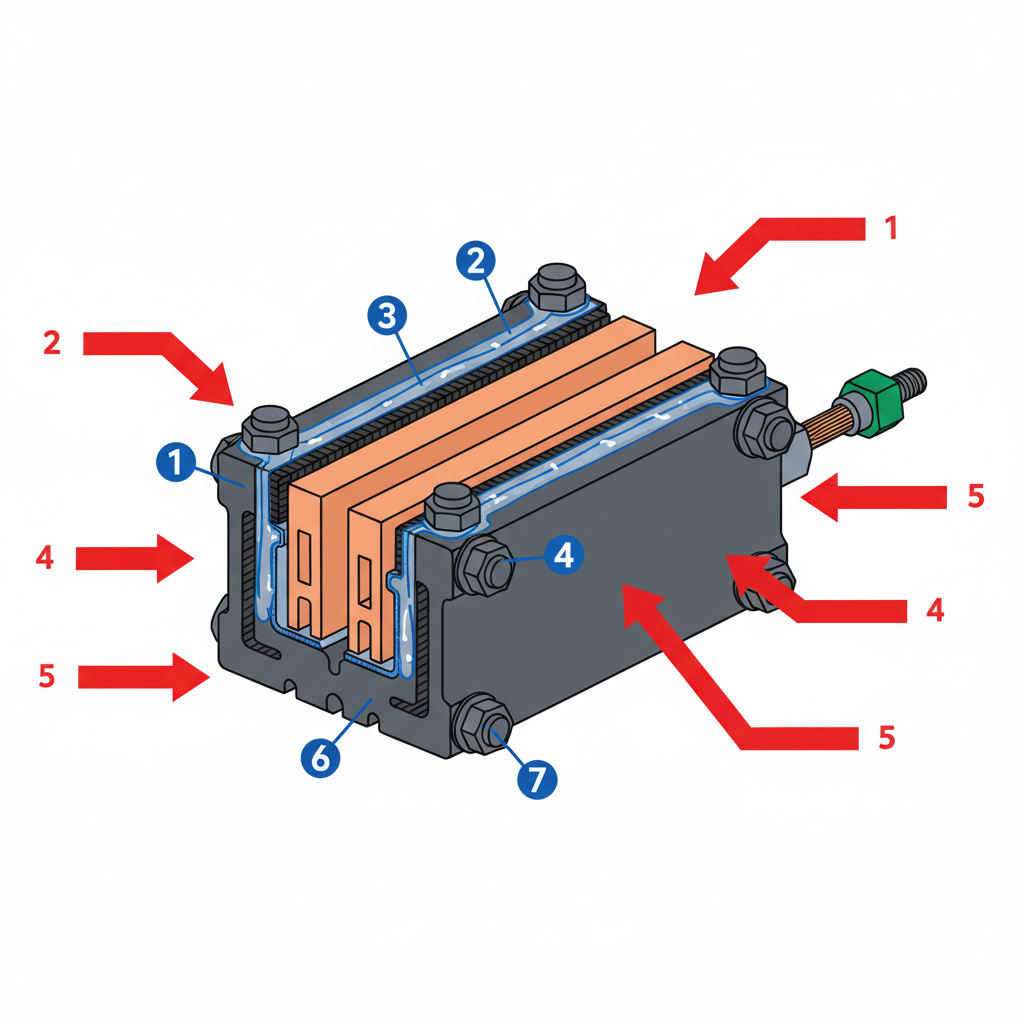
Joint assembly in humid environments must follow a dry-first, seal-second sequence — conductors must be torqued to specification before any sealant is applied, because applying sealant first traps air pockets that later collapse and create voids under thermal cycling.

Conductor surface preparation begins with the application of a non-oxidizing, humidity-rated contact grease to all mating conductor surfaces. This grease serves two functions: it displaces any residual moisture from the contact interface and it prevents oxidation from forming in the period between assembly and first energization.

Torque specification compliance is critical in both directions. Under-torquing leaves micro-gaps at the contact interface that fill with moisture. Over-torquing deforms the conductor surface and can crack the insulation at the joint edge. Both failure modes are more consequential in humid environments than in dry ones. Use a calibrated torque wrench, verify the specification for the specific joint size, and document the torque readings.

Sealant application follows conductor torquing. The sealant bead must be continuous — no gaps, no bridging, no areas where the bead thins to less than the specified cross-section. We use silicone-based sealant exclusively for vulcanized rubber systems. Any gap in the sealant bead is a direct moisture ingress path into the joint interior.

Before housing bolts are torqued, verify that the IP gasket is fully seated in its groove around the entire joint perimeter. A gasket that has been partially displaced during handling will not compress correctly, and the resulting leak path is typically invisible until the joint fails.

How Do You Verify Grounding Continuity in Humid Environments?

Grounding continuity in humid environments must be verified with a dedicated low-resistance ohmmeter test, not assumed from visual inspection — moisture-induced oxidation at grounding contact points can create a technically "connected" but electrically inadequate ground path.

The target ground resistance across the full installed run is less than 0.1Ω. Readings above this threshold indicate oxidation or inadequate contact at one or more grounding connection points and must be investigated before commissioning.

Anti-oxidation compound must be applied at every grounding contact point — not selectively, not on the ones that look like they need it. In a humid environment, the ones that look fine at installation are the ones that oxidize during the first rainy season.

Grounding conductor routing deserves attention that it rarely receives. Low points in the grounding conductor run collect condensation. Where the routing geometry creates a low point, install a drainage provision or reroute to avoid it. A grounding conductor sitting in pooled condensate is a corrosion timeline, not a protection system.

ZHERUTONG's installation protocol for humid-climate projects was developed iteratively from field feedback across multiple deployments. The grounding verification requirement, in particular, was added after a coastal facility inspection revealed that three of twelve grounding connection points had developed oxide layers sufficient to increase ground resistance above 1Ω within fourteen months of commissioning — despite visual inspection showing no obvious deterioration.

---

H2-5: How Should You Select the Right IP Rating and Accessories for Humid Sites?

For environments with sustained humidity above 80% RH, IP54 is a minimum threshold — not a target — and in facilities with direct water spray, steam, or regular washdown, IP65 or IP66 rated vulcanized insulated busbar trunking systems should be the baseline specification.

The most common IP rating error we see in humid-environment projects is specifying based on normal operating conditions rather than worst-case condensation events. A coastal substation that operates at 75% RH on a typical day can experience 98% RH at housing surfaces during a cold-front temperature drop. A food processing facility that runs at 85% RH during production undergoes high-pressure washdown cycles that create direct water impingement on all exposed surfaces. The IP rating must cover the worst case, not the average.

The following matrix reflects ZHERUTONG's recommendations based on project data from humid-climate deployments:

Environment Type

Minimum IP Rating

Notes

Coastal industrial substation

IP54

Upgrade to IP65 if salt fog exposure is present

Food processing — wet production floor

IP65

IP66 for facilities with high-pressure washdown

Chemical plant — humid process areas

IP65

Verify gasket material compatibility with specific chemicals

Paper mill — steam-exposed areas

IP66

Consider stainless housing for aggressive steam chemistry

Cold-room / refrigerated facility

IP55 minimum

Thermal cycling between cold and ambient creates condensation events

Accessory specification is where IP ratings fail in practice even when correctly specified on paper. End-caps must use a dual-seal design — a single-lip gasket is insufficient for sustained high-humidity exposure. Plug-in unit covers must be spring-loaded self-closing type; open plug-in ports are direct condensation entry points during tap-off operations. Expansion joints must accommodate thermal cycling without breaking the IP seal at the joint interface — this requires a bellows-type design rather than a sliding-gap design in applications with significant temperature cycling range.

---

H2-6: What Does a Real High-Humidity Installation Look Like in Practice?

A food processing facility in coastal Southeast Asia gave us the clearest proof that installation protocol — not product specification — is what determines long-term performance in high-humidity environments.

The facility operates on the coast of Malaysia, in a production environment where ambient humidity consistently measures between 88% and 95% RH. Daily high-pressure washdown cycles cover the entire production floor, including the overhead power distribution zone. The operating environment is, by any measure, among the most demanding conditions a busbar trunking system can face.

The facility had previously installed a PVC-insulated busbar trunking system sourced from a different supplier. Within eighteen months of commissioning, the system had experienced three insulation failures — all at joint locations. Each failure caused production downtime. The cumulative cost of downtime, emergency repair, and partial system replacement had exceeded the original system purchase price.

When ZHERUTONG's application engineering team conducted an on-site inspection, the diagnosis was consistent with what we've seen in similar environments. The PVC insulation had absorbed moisture and delaminated at joint transitions, creating direct leakage paths between phase conductors and housing. The original installation had included no dew point verification procedure and no joint sealant protocol — the joints had been assembled according to a standard installation guide written for temperate indoor environments.

ZHERUTONG supplied a replacement system using vulcanized rubber insulated busbar trunking rated IP65, with silicone gaskets specified at all joints, anti-oxidation compound mandated at all grounding connection points, and a documented installation protocol delivered as part of the product package. The installation protocol included a mandatory pre-installation IR test requirement and a 4-hour dehumidification window before joint assembly — requirements that the installation crew initially pushed back on as unnecessary schedule additions.

After twenty-six months of continuous operation under the same humidity and washdown conditions, the system showed zero insulation failures. IR readings taken at all joints during a scheduled inspection remained above 500 MΩ, compared to the 100 MΩ baseline established at commissioning. The client reported zero unplanned electrical downtime attributable to the busbar system during the entire period.

The application engineer who led the project put it directly: "The product was only half the solution. The other half was convincing the installation crew that a 4-hour dehumidification window before joint assembly wasn't optional — it was the difference between a 20-year system and a 2-year replacement cycle."

That's the case for taking this installation guide seriously. The product performs. The installation protocol is what determines whether the product gets the chance to perform for its full service life.

---

Frequently Asked Questions

Can vulcanized insulated busbar trunking be installed outdoors in tropical climates?

Yes, with IP66 or IP67 rated enclosures and UV-stabilized outer housing specified. Outdoor tropical installations introduce additional considerations beyond the humidity protocol described in this guide — specifically, thermal expansion from direct solar loading and UV degradation of the outer sheath over time. These require separate specification attention, and ZHERUTONG's engineering team can advise on the appropriate housing treatment and expansion joint spacing for specific outdoor tropical configurations.

How often should insulation resistance be tested after installation in high-humidity environments?

ZHERUTONG recommends a baseline IR test immediately post-installation, followed by a 3-month test, a 12-month test, and annual testing thereafter. Any reading below 100 MΩ at any joint location should trigger immediate joint inspection — don't wait for the next scheduled test. Early-stage insulation degradation in humid environments is reversible if caught at the 100 MΩ threshold; it is not reversible once surface tracking has established a conductive path.

What is the minimum conductor temperature for joint assembly in a cold-room facility?

Joint assembly should not proceed when conductor temperature is below 5°C. Below this threshold, silicone sealant viscosity increases to the point where achieving a continuous void-free bead becomes unreliable, and IP gasket compression behavior changes in ways that can leave residual gaps. Cold-room installations require pre-warming of joint components to at least 10°C before assembly begins — a heat blanket or warm storage enclosure is sufficient.

Does vulcanized insulation require special disposal or handling at end-of-life?

Vulcanized rubber is not recyclable in the same material stream as PVC. It requires separation from copper conductors before copper recycling can proceed, and the rubber compound itself may require specific waste classification depending on local environmental regulations. This is worth factoring into total lifecycle cost assessments when comparing vulcanized rubber insulated busbar trunking vs PVC insulated busbar trunking — particularly in jurisdictions with strict industrial waste regulations.

How does ZHERUTONG handle custom IP rating requirements for non-standard humid environments?

ZHERUTONG's engineering team reviews project-specific environment data — including RH profile, temperature cycling range, washdown frequency, and chemical exposure type — and specifies gasket material, housing surface treatment, and accessory configuration accordingly. Custom configurations are available within standard lead times for most project specifications. Send your site conditions and project requirements to rtdq@rtbusway.com and the application engineering team will respond with a specific system recommendation.

---

What Should You Do Before Your Next Humid-Environment Project?

The gap between a vulcanized insulated busbar trunking system that lasts five years and one that lasts twenty-five years in a humid environment is almost entirely determined by what happens during installation. The product is the starting point, not the ending point. A correctly specified system installed with the wrong protocol will fail on the same timeline as a poorly specified system. A correctly specified system installed with the protocol described in this guide will perform for its full design life — and we have twenty-six months of field data from one of the most demanding humid environments in the region to support that claim.

Every humid-environment project has its own specific variables: a particular humidity profile, a specific chemical exposure, a unique thermal cycling range. Generic installation instructions cannot account for all of them. What we've described here is a framework — the non-negotiable foundation. The project-specific layer requires project-specific review.

ZHERUTONG provides both the product and the installation protocol, because we've seen what happens when they're separated. If you're specifying or procuring vulcanized insulated busbar trunking for a high-humidity project, send your project requirements, site conditions, or drawings to rtdq@rtbusway.com. Our application engineering team will review your specific environment and recommend the appropriate system configuration, IP rating, and installation protocol. Sample requests and custom configurations are welcome.

CONTACT US

If you have any queries, get in touch today! Don't hesitate. We try to take the extra step for our customer satisfaction.
First Name*
Company Name*
Email*
Last Name
Country
Message*
Leave a message
First Name*
Company Name*
Email*
Last Name
Country
Message*