catégorie

How Do You Design a Custom Busway System for a Manufacturing Facility Layout?

Most busway failures start with poor planning. Learn how custom busway system design for manufacturing facility layout prevents costly rework when production lines change.
Jun 18th,2026 2 Vues

Most power distribution problems in industrial facilities aren't caused by the wrong product. They're caused by a layout design process that was never properly structured in the first place. At ZHERUTONG, we've worked through busway design challenges across manufacturing sites in Southeast Asia, Europe, and the Middle East — and the pattern repeats itself with uncomfortable consistency: a facility installs a standard catalog busway, it works adequately for the first production configuration, and then the first layout change exposes every assumption that was baked into the original design.

A standard catalog busway can be installed in days. But it rarely survives the first production line reconfiguration without costly rework — because it was never designed around how that facility actually operates. This article walks through the actual design decision sequence that determines whether a custom busway system serves a facility for five years or fifteen.

Why Does a Standard Busway Fail in Complex Manufacturing Layouts?

Standard busway products are engineered for predictable, static load environments — and most manufacturing facilities are neither predictable nor static.

What Makes Manufacturing Layouts Structurally Different?

Unlike office or commercial spaces, manufacturing facilities combine irregular column grids, overhead crane clearances, variable equipment footprints, and phase-load imbalances that standard busway runs cannot accommodate without custom intervention.

The "fixed tap-off window" problem is one of the first things our engineering team identifies on any site review. Standard plug-in busway locks tap locations at preset intervals — typically every 600mm or 1200mm depending on the product family. That sounds reasonable until you're trying to serve a production line where equipment spacing is driven by process flow, not by where the catalog says a tap-off should be.

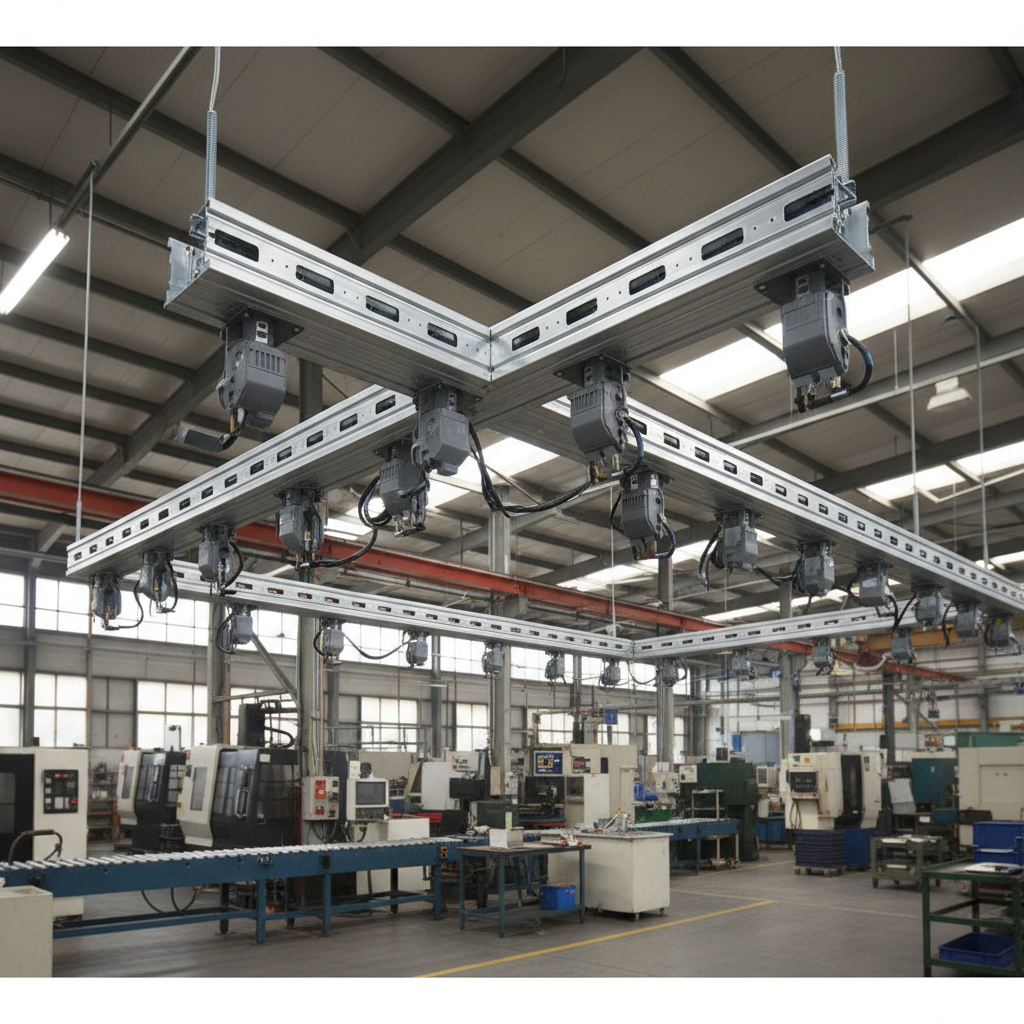
Overhead obstructions compound this immediately. Crane rails, HVAC ductwork, conveyor systems, and mezzanine structures force non-linear routing that standard straight sections and 90-degree elbows simply can't resolve without field modification. In heavy assembly environments, a busway run may need to change elevation twice, navigate around a 5-ton crane rail, and still arrive at the correct position above a CNC machine — all within a 15-meter span.

Load variability adds a third layer of complexity. A single production line can draw anywhere from 60A to 800A depending on shift configuration, machine state, and whether auxiliary systems are running. Standard ampacity ratings are fixed at the product level — they don't account for the range of real-world demand variation within a single run.

From our internal project review across Southeast Asian and European manufacturing clients, approximately 67% of busway replacement requests were triggered not by product failure but by layout incompatibility with evolving production floor configurations. The busway itself was functioning correctly. The design was wrong from the start.

How Do Ceiling Height and Mounting Method Affect Route Planning?

Ceiling height determines whether a busway run can be ceiling-suspended, wall-mounted, or pole-supported — and each mounting method carries different structural load calculations and maintenance access implications.

Ceiling suspension is preferred for spans above 4.5 meters. It requires hanger spacing calculations based on busway weight per meter and, in seismic-active regions, compliance with local seismic zone requirements. Getting this wrong doesn't just create a maintenance problem — it creates a safety liability.

Wall-mount configurations become necessary when overhead crane clearance prohibits ceiling suspension. This introduces horizontal-to-vertical transition fittings that must be custom-fabricated, because catalog elbows are designed for standard offset dimensions that rarely match the actual geometry of a real facility wall column.

Vertical pole support is common in open-floor automotive and heavy assembly facilities. It allows repositioning without ceiling penetration permits — a practical advantage in facilities that operate under strict change management protocols. IP rating selection also enters the decision here: dust-heavy grinding zones, coolant spray areas near CNC equipment, and high-humidity zones near washing stations each require different enclosure ratings that a single catalog product won't cover uniformly.

How Do You Actually Map a Custom Busway Layout Across a Facility Floor Plan?

Mapping a custom busway layout starts not with the busway itself, but with a load schedule audit and an equipment positioning matrix — two inputs that most facility teams skip, and later regret.

What Information Must You Gather Before Drawing a Single Busway Run?

Before routing a single meter of busway, you need four confirmed inputs: total connected load per zone, equipment repositioning frequency, future capacity headroom requirement, and structural ceiling/floor load ratings.

The load schedule audit is where most facilities discover that their nameplate data is significantly misleading. ZHERUTONG's engineering team consistently finds a 20–35% gap between nameplate totals and actual measured peak draw in facilities that haven't been audited in over three years. Machines that are nominally rated at 100A may consistently draw 60A under normal production conditions — or spike to 140A during startup sequences. Designing to nameplate totals in this environment produces an oversized, over-cost system that still fails to deliver power where it's actually needed.

The equipment positioning matrix is the second document that most teams don't have. This maps which machines move seasonally (die changes, model year transitions), which are fixed infrastructure, and which are likely to be replaced within a five-year planning horizon. A busway run designed without this matrix will need to be partially redesigned within 18 months in most active manufacturing environments.

Future capacity headroom follows from both of the above. Industry practice suggests designing for 125% of current peak load as a minimum. Facilities planning automation upgrades — adding robotic welding stations, automated guided vehicles, or high-cycle press lines — should target 150% to avoid a capacity-driven redesign before the first automation phase is complete.

Structural constraints close out the pre-design checklist: ceiling load ratings, fire suppression zone boundaries, and emergency egress clearances all constrain routing options before the first elbow fitting is selected.

How Do You Choose Between a Feeder Run and a Plug-In Run?

Feeder runs carry bulk power between major distribution points with no tap-off access; plug-in runs distribute power directly to equipment — and most manufacturing facilities need both, in a deliberate hierarchy.

The spine-and-branch model is the most practical framework for large-floor manufacturing layouts. A feeder busway backbone runs from the main switchgear room to zone distribution panels, carrying high ampacity over long distances without tap-off complexity. Custom busway plug-in branches then serve individual production cells from those zone panels, delivering power directly to equipment with flexible tap-off positioning.

When to use plug-in busway at the zone level: equipment spacing under 6 meters, frequent layout changes expected, mixed ampacity requirements across adjacent machines. When feeder-only runs make sense: long backbone distances over 30 meters, high-ampacity backbone above 2000A, where no tap-off is needed along the route.

The transition fitting between feeder and plug-in runs is frequently where custom fabrication becomes unavoidable. Standard catalog elbows and tees are designed for standard offset dimensions. Real facility column grids almost never match those dimensions exactly.

Facility Zone Scenario

Recommended Run Type

Typical Ampacity Range

Key Design Consideration

Main switchgear to sub-panel

Feeder busway

800A–4000A

Voltage drop over distance

Production cell power spine

Plug-in custom busway

100A–800A

Tap-off spacing flexibility

Single machine dedicated drop

Custom branch with plug-in unit

30A–250A

Amperage configuration per load

Mixed-use assembly zone

Hybrid feeder + plug-in

400A–1200A

Future reconfiguration access

How Do Custom Busway Plug-In Unit Amperage Configuration Options Affect Layout Decisions?

The amperage configuration of each plug-in unit isn't a detail you finalize after the layout is drawn — it's a variable that directly determines how many tap-off points a single busway run can safely support, and where those points must be positioned.

What Amperage Range Do Manufacturing Plug-In Units Actually Need?

In manufacturing environments, plug-in unit amperage requirements typically span from 30A for instrumentation and control panels to 400A or above for CNC machining centers and robotic welding stations — and a single busway run often needs to serve both extremes simultaneously.

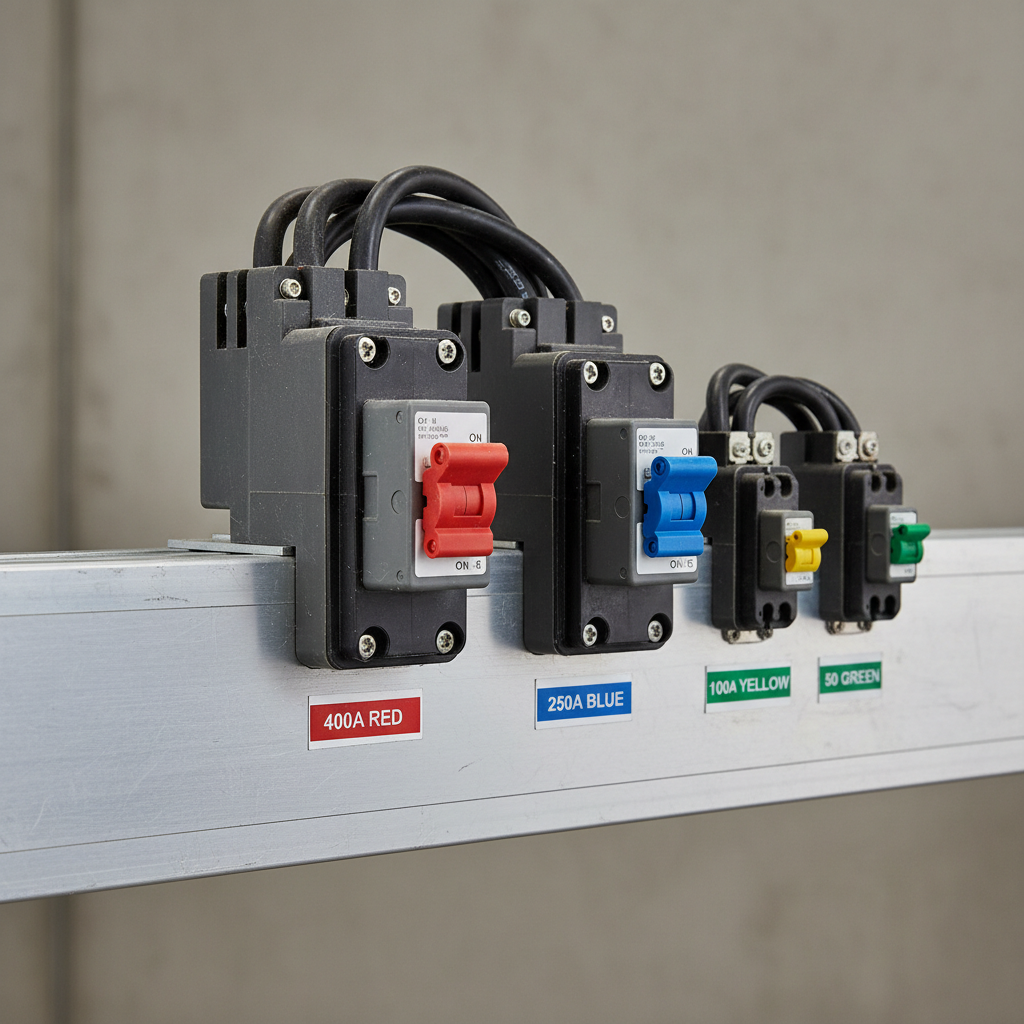
Common manufacturing plug-in amperage tiers run at 30A, 60A, 100A, 125A, 200A, 250A, and 400A. Each tier corresponds to a different breaker frame and plug-in unit body size, which means the busway housing must accommodate varying unit widths along the same run — a configuration that standard catalog systems handle poorly, if at all.

The mixed-load challenge is where facilities most frequently make costly procurement errors. When a busway run serves machines with dramatically different amperage requirements, the plug-in unit configuration must account for cumulative load without exceeding the busway's rated ampacity at any point along the run. This isn't a theoretical concern — it's a commissioning failure mode that we've been called in to resolve on more than one occasion after a standard system was installed without this analysis.

From ZHERUTONG's engineering observations: facilities that attempt to standardize all plug-in units to a single amperage rating — typically 100A, chosen for procurement simplicity — end up with either chronic undervoltage at high-draw machines or wasted capacity at lighter loads. Neither outcome is acceptable in precision manufacturing, where voltage stability directly affects process tolerances.

How Does Plug-In Unit Positioning Interact with Busway Ampacity Derating?

Every plug-in unit placed on a busway run draws current that reduces available capacity for downstream units — a calculation that must be modeled before installation, not discovered during commissioning.

Starting from the power feed unit, each plug-in tap reduces available ampacity for every unit further along the run. The final unit on a run must not push total draw beyond 80% of rated busway ampacity under NEC continuous load guidelines. This 80% rule is frequently cited but less frequently modeled correctly — particularly in facilities where shift-based load variation means that the "worst case" draw scenario only occurs during certain production windows.

ZHERUTONG's custom busway plug-in unit amperage configuration options include mixed-frame units within a single run, color-coded by voltage and amperage for maintenance identification, with optional integrated MCCB protection per tap-off point. This last feature — individual breaker protection at each plug-in — allows maintenance teams to isolate a single machine without affecting adjacent equipment on the same run, which is operationally significant in facilities running continuous production shifts.

Thermal derating in high-ambient environments is a factor that catalog-spec busway frequently ignores but custom-engineered systems must address explicitly. Manufacturing floors with ambient temperatures above 40°C require ampacity derating calculations that reduce the effective capacity of a given busway section. In facilities near tropical climates with limited HVAC coverage over the production floor, this derating can reduce effective ampacity by 10–15% — enough to push an undersized system into overload territory during peak production periods.

Integrated IR windows on plug-in units address a related maintenance concern: in high-cycle manufacturing environments, thermal scanning of energized connections is standard practice for predictive maintenance programs. Units with factory-installed IR windows allow thermographic inspection without shutdown, directly reducing unplanned downtime.

What Does a Real Custom Busway Design Project Look Like from Brief to Installation?

The most instructive way to understand custom busway system design is to follow a real project through every decision point — from the initial facility drawings to the final commissioning check.

Case Study: Automotive Parts Manufacturer, Southeast Asia

An automotive stamping and assembly facility in Thailand operating three production shifts across a 12,000 m² floor with 47 pieces of major equipment — ranging from 15-ton hydraulic presses to precision CNC grinding stations — came to us after their third production expansion had pushed their existing electrical infrastructure past its practical limit.

The facility had expanded capacity twice using traditional conduit-and-wire drops. By the time the third expansion was planned, the electrical team was facing a ceiling grid that was visually and physically overloaded: 23 separate conduit runs competing for the same overhead space as a 5-ton overhead crane rail. Any further expansion would require shutting down two production zones for an estimated six weeks to reroute conduit. The facility's electrical engineer described the situation directly: "We weren't designing a power system anymore. We were managing a conduit maze that was growing faster than we could document it."

ZHERUTONG's engineering team began with a full load schedule audit that revealed 11 of the 47 machines were operating at less than 40% of their nameplate draw during normal production — significant overcapacity in the existing wiring that had never been quantified. This finding directly shaped the busway sizing approach.

The design solution was a two-tier custom busway layout: a 1600A feeder busway backbone running 68 meters along the facility's central spine, with four custom plug-in busway branch runs serving individual production cells. Across the branch runs, 34 plug-in units were configured with mixed amperage ratings — 60A, 125A, and 250A — matched to actual measured machine loads rather than nameplate values. Three non-standard offset fittings were fabricated to navigate the crane rail clearance zone; these had no catalog equivalent and were produced to drawing at ZHERUTONG's manufacturing facility.

Installation was completed during a scheduled 9-day maintenance window, compared to the projected 6-week conduit rework. Overhead space reclaimed reduced visual obstruction by approximately 60%, restoring safe crane operating clearances. Two subsequent production line reconfigurations were completed by the facility's own maintenance team by repositioning plug-in units — no licensed electrician callout required for either change. The facility's procurement lead noted that total installed cost came in 18% below the conduit rework estimate, even with custom fabrication included.

How Do You Evaluate Whether a Custom Busway Supplier Can Actually Deliver?

The gap between a supplier who can quote a custom busway system and one who can actually engineer, fabricate, and support it through installation is wider than most procurement teams realize until a project is already in trouble.

What Technical Capabilities Should a Custom Busway Manufacturer Demonstrate?

A credible custom busway manufacturer should be able to provide load-specific ampacity calculations, non-standard fitting fabrication from client drawings, and documented thermal testing results — not just a modified catalog quote.

In-house fabrication capability for non-catalog fittings is the first capability to verify. Elbows, offsets, tees, and transition sections to exact facility dimensions cannot be sourced from a distributor — they must be manufactured to drawing. A supplier who outsources this fabrication introduces a lead time and quality control variable that can derail a project timeline during installation.

Mixed amperage plug-in unit configuration within a single run is the second capability that separates manufacturers from catalog resellers. If a supplier can only offer uniform amperage across a run, they're selling a standard product with a custom label.

Documented short-circuit withstand ratings matched to the facility's upstream protection device are non-negotiable for any installation that will be submitted for electrical inspection. A supplier who cannot provide these ratings — tested, not calculated — is not a suitable source for a manufacturing facility installation.

ZHERUTONG's standard pre-project checklist collects seven facility parameters before any custom busway design proposal is issued: connected load schedule by zone, ambient temperature range, seismic zone classification, crane clearance envelope, ceiling load rating, IP rating requirements by floor zone, and future expansion timeline. A supplier who quotes without collecting this information is quoting a catalog product, not a custom system.

---

FAQ

Q1: How long does it typically take to design and manufacture a custom busway system for a manufacturing facility?

Design and engineering review typically takes 5–10 business days once complete facility drawings and load schedules are received. Manufacturing lead time for custom runs with non-standard fittings ranges from 3–6 weeks depending on complexity and conductor material selection.

Q2: Can a custom busway system be expanded after initial installation if production capacity increases?

Yes — this is one of the primary advantages of a well-designed custom busway layout. Provided the original busway run was specified with adequate ampacity headroom, additional plug-in units can be added at any accessible point along the run without modifying the backbone infrastructure.

Q3: What is the minimum information needed to start a custom busway design consultation?

At minimum: a facility floor plan with equipment positions marked, a load schedule or equipment nameplate list, ceiling height and mounting constraint notes, and the location of the main power feed point. Crane clearance envelopes and ambient temperature ranges are also critical for manufacturing environments.

Q4: How do custom busway plug-in unit amperage configuration options affect maintenance requirements?

Mixed-amperage plug-in configurations require clear labeling and documentation. ZHERUTONG recommends color-coded unit identification and a zone-by-zone load map delivered with every custom system. Integrated MCCB protection per plug-in unit allows individual machine isolation without affecting adjacent equipment on the same run.

Q5: Is a custom busway system more expensive than a standard catalog busway installation?

The upfront cost of custom fabrication is typically 15–30% higher than an equivalent standard catalog system. However, when total installed cost is calculated — including conduit elimination, reduced labor hours, and avoided future reconfiguration costs — custom busway systems consistently deliver lower lifecycle cost in facilities with dynamic production layouts.

---

A manufacturing facility's power distribution system should be designed around how the facility actually operates — not around what happens to be available in a catalog. Every custom busway project ZHERUTONG has worked through has started with the same first step: a detailed conversation about the facility's layout, its load reality, and where it's headed in the next five years.

If you're at that starting point — with floor plans, a load schedule, or even just a set of questions — send your project details to rtdq@rtbusway.com. ZHERUTONG's engineering team reviews every inquiry and responds with a technical assessment, not a catalog link.

CONTACT US

If you have any queries, get in touch today! Don't hesitate. We try to take the extra step for our customer satisfaction.
First Name*
Company Name*
Email*
Last Name
Country
Message*
Leave a message
First Name*
Company Name*
Email*
Last Name
Country
Message*