catégorie

How Do You Correctly Size Compact Busway Current Ratings for Data Centers?

Most busway comparison articles spend their time explaining the difference between compact and air-insulated systems — the sandwich construction, the epoxy insulation, the lower impedance. That content is useful the first time you're learning what busway is. It's useless the day you're actually staring at a load schedule and need to decide whether a data hall needs 1000A or 1600A busway feeding its row-level distribution.
Jul 25th,2026 2 Vues

Most busway comparison articles spend their time explaining the difference between compact and air-insulated systems — the sandwich construction, the epoxy insulation, the lower impedance. That content is useful the first time you're learning what busway is. It's useless the day you're actually staring at a load schedule and need to decide whether a data hall needs 1000A or 1600A busway feeding its row-level distribution.

At ZHERUTONG, we spend a good part of our week on exactly that second problem. Engineers and OEM customers send us load calculations, single-line diagrams, and retrofit floor plans, and they're not asking "what is compact busway." They're asking whether their numbers add up, whether their growth margin is realistic, and — increasingly, for brownfield colocation projects — whether there's even enough physical clearance to install the busway they've specified.

This article walks through both problems together: how to size compact busway current ratings for data center loads, and what clearance a retrofit installation actually demands once the sizing decision is made. Getting the amperage class right on paper and then discovering there's no room to insert a tap-off box in the ceiling void is a failure mode we see more often than most people expect.

What Load Factors Actually Drive Compact Busway Sizing?

Compact busway sizing in a data center is driven by four factors together — rack power density in kW, diversity/growth factor, ambient temperature inside the electrical room, and the voltage drop tolerance of the run — not by nameplate load alone.

Nameplate load is what's printed on the equipment. Actual demand is what the facility draws once diversity, redundancy topology, and real utilization are factored in. Sizing to nameplate almost always overstates the immediate need, while sizing to Day-1 measured demand without a growth allowance almost always understates the five-year need. Both mistakes are common, and both are avoidable with a checklist rather than a guess.

Rack density is the variable that's changed the most in recent years. Traditional enterprise data halls were commonly designed around 5-8 kW per rack. AI and HPC-oriented halls are now routinely designed for 15-30 kW per rack, and some accelerator-dense racks push well beyond that. This shift alone can double or triple the current a row-level busway run needs to carry compared to a legacy design template.

Diversity and growth factor account for the fact that not all connected load runs simultaneously, but future racks will be added. A busway sized exactly to today's IT load, with zero margin, is a busway that gets swapped out in three to five years when the next expansion phase lands — an expensive and disruptive fix compared to sizing correctly the first time.

Ambient temperature inside electrical and battery rooms matters because busway ampacity ratings are established at a reference ambient (commonly 40°C or similar, depending on standard and manufacturer). Rooms that run hotter — rooftop electrical rooms, poorly ventilated risers, spaces adjacent to UPS battery banks — reduce the safe current-carrying capacity of the same physical busway. A run rated for 1600A in a 40°C reference environment does not necessarily carry 1600A safely in a 50°C rooftop enclosure.

Voltage drop is the factor most often skipped because it doesn't show up as a hard failure the way overcurrent does. A run that's electrically undersized for its length will still function — it will just waste energy and potentially cause downstream equipment to see lower-than-expected voltage, which matters more in sensitive IT power chains than in general industrial distribution.

How Do You Calculate Required Current From kW Load?

For a balanced three-phase system, required current is calculated as I = P / (√3 × V × PF), where P is the load in watts, V is line voltage, and PF is power factor.

Take a hypothetical data hall with a projected demand of 900 kW at 415V line voltage and a power factor of 0.95. The calculation runs: I = 900,000 / (1.732 × 415 × 0.95), which comes out to roughly 1,320A. Round up — never down — to the next standard current class, which in this case would be 1600A rather than a 1250A run that's already undersized before a single future rack is added.

Rounding down to save on material cost is the single most common false economy we see in early-stage specifications. The margin between 1320A calculated and 1250A rated might look small on paper, but it leaves zero room for diversity assumptions being slightly optimistic, for future load growth, or for ambient derating eating into the nameplate rating.

Why Does Ambient Temperature Change the Rating?

Busway current ratings are established at a specific reference ambient temperature, and running the same physical busway in a hotter room reduces the current it can safely carry without derating.

This is a thermal problem, not an electrical one — the conductor cross-section doesn't change, but its ability to shed heat into a warmer surrounding air does. A busway model rated 1250A in a temperature-controlled electrical room may need to be derated by a meaningful margin — often in the range of a few percentage points for every few degrees above the reference ambient — if installed in a rooftop switchroom or an enclosed riser shaft with limited airflow. The practical implication is simple: don't select a current class based on the catalog number alone. Ask what ambient temperature that number assumes, and compare it against what the actual electrical room will experience during summer peak cooling load, not during a mild spring afternoon.

How Do You Choose Between Standard Current Classes?

The right current class comes from rounding your calculated demand up to the nearest standard rating — such as 800A, 1000A, 1250A, 1600A, or 2000A — while leaving a growth margin of roughly 20-25% for future rack additions.

"Just enough" sizing is a false economy in a data center context because the cost of replacing an undersized busway run — downtime, re-engineering, demolition of finished ceiling and wall assemblies, and the busway hardware itself — dwarfs the incremental cost of specifying one class higher on Day 1.

Current Class

Typical Data Center Use Case

Typical Conductor Choice

400-800A

PDU feed, small IT room, edge facility

Copper, occasionally aluminum for cost-sensitive edge sites

1000-1250A

Row-level distribution, medium data hall

Copper preferred for compact footprint

1600-2500A

Main switchboard tie, high-density AI/HPC hall

Copper for high-density runs; aluminum where weight matters more than footprint

3200A+

Utility-to-switchgear main feed, campus-scale distribution

Copper dominant, aluminum considered for very long overhead runs


Copper and aluminum trade off differently depending on where in this table you're sitting. At lower current classes the footprint difference is modest and copper's higher conductivity per cross-sectional area often wins out, especially where ceiling void height is tight. At higher current classes, aluminum's weight advantage becomes more relevant for long overhead runs supported by cable tray or dedicated hangers — a 3200A copper run is considerably heavier per meter than an equivalent aluminum run, which matters for structural loading in retrofit ceilings that weren't originally designed to carry that weight.

Should You Size for Today's Load or Future Growth?

Data centers are almost always built in phases, so busway should generally be sized for the facility's planned build-out rather than only the load present at commissioning.

One advantage of busway over cable-and-conduit is exactly this: modularity. Tap-off boxes can be added at later phases without touching the main run, provided the run itself was sized for the eventual load. We've worked with OEM customers who deliberately over-specified the trunk run current class in phase one of a colocation build specifically so that phases two and three could add row PDUs without a single feeder swap. The upfront cost difference between one current class and the next is small compared to the cost of a mid-life busway replacement in a live facility.

Does Copper or Aluminum Change the Sizing Outcome?

Yes — because copper and aluminum have different ampacity per cross-sectional area, achieving the same current rating in aluminum requires a larger conductor, which changes the physical envelope and weight of the finished busway run.

For equivalent ampacity, aluminum conductors typically need roughly 1.6 times the cross-sectional area of copper. That translates into a wider or thicker busway housing for the same current class, which matters in overhead cable tray routes where every extra centimeter of clearance is contested space shared with cooling ductwork and fire suppression piping. Copper's compactness at a given rating is one reason it remains the default choice for high-density data hall busway despite its higher material cost.

How Do You Verify Sizing With Short-Circuit and Derating Checks?

A current rating is only correct if it also survives the site's short-circuit withstand requirement and any installation-specific derating from enclosure orientation, ambient heat, or grouping with other busway runs.

A calculated current rating that ignores fault conditions is a paper-correct answer that can fail in the field. Short-circuit withstand ratings for compact busway commonly range from around 50 kA up to 100 kA or higher depending on current class and manufacturer, and this figure needs to be cross-checked against the fault current available at that point in the distribution system, as determined by the upstream protective device and transformer impedance. A busway rated correctly for steady-state current but under-rated for the available fault current is a latent safety problem, not a capacity problem.

Grouping derating applies when multiple busway runs share a vertical riser shaft or run in close proximity along the same tray. Heat generated by adjacent runs raises the effective ambient temperature each run experiences, which can require a further derating step beyond the room's baseline temperature. This is frequently missed in early design because single-run calculations look fine in isolation.

Orientation also matters. Busway installed edgewise, flat, or vertically in a riser doesn't always carry identical ampacity to the same busway installed horizontally, depending on how the manufacturer's housing manages convective heat loss. This is one area where catalog maximum figures can mislead — a manufacturer's headline current rating is often tested under a specific, favorable orientation and ambient condition. The practical habit worth building is simple: request actual test data or a datasheet showing the conditions behind the rated figure, rather than assuming the catalog number applies unconditionally to your installation.

What Clearance Do You Need When Installing Compact Busway in a Retrofit Project?

Retrofit installations typically need more clearance than new builds — enough vertical and side access for tap-off box insertion, thermal imaging inspection, and joint torque checks, often 150-300mm beyond the busway's physical envelope depending on current class.

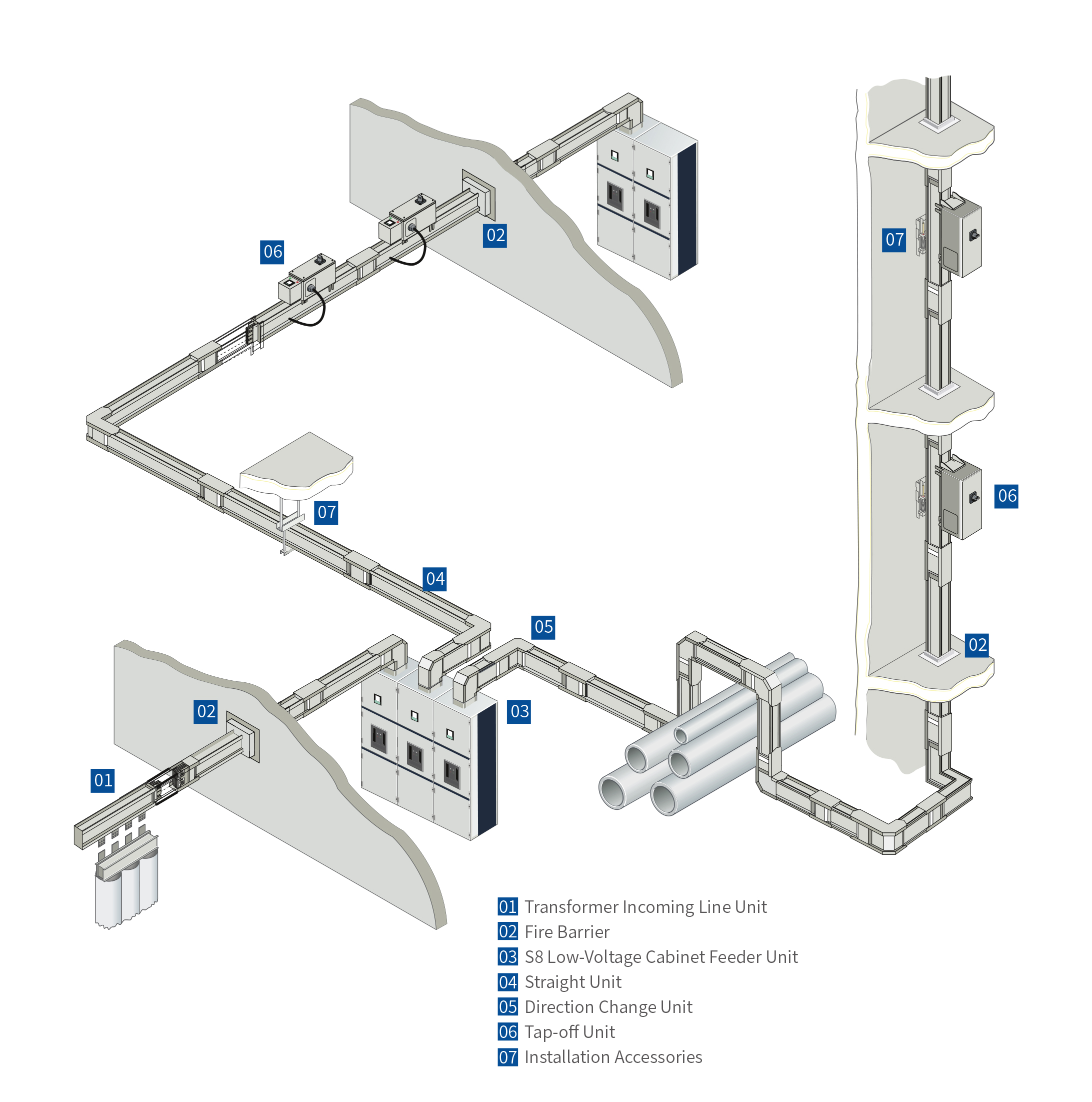
Compact busway installation clearance requirements in retrofit projects differ from greenfield design for a straightforward reason: greenfield design lays out cable trays, cooling ducts, and structural elements around the busway route from a blank sheet. Retrofit design has to fit a new busway run into a ceiling void or riser shaft that's already crowded with existing infrastructure — sprinkler mains, chilled water piping, legacy cable tray, structural bracing that wasn't in any as-built drawing.

The clearance figure isn't arbitrary. It has to accommodate a technician physically inserting or removing a tap-off box without de-energizing the entire run, sliding a thermal imaging camera along the joint line during a live inspection, and getting a torque wrench onto a joint bolt without dismantling adjacent trays. Higher current classes generally need more side clearance because the tap-off boxes themselves are physically larger.

We've seen retrofit projects where the busway route was specified purely on electrical grounds — current class, conductor material, run length — without anyone walking the actual ceiling void first. The result was a mismatch discovered during installation: a fire sprinkler branch line sitting exactly where a tap-off box needed to be inserted, forcing a mid-installation reroute that cost more time than a proper site survey would have taken at the design stage. The lesson from that project became a standing practice for us — always request as-built photos or a laser scan of the retrofit path before finalizing clearance-dependent components like tap-off box spacing.

What Changes When Retrofitting an Occupied Data Hall?

Retrofitting a live data hall requires phased de-energization, careful sequencing around adjacent live busway runs, and installation windows planned to avoid disrupting operating racks.

Unlike a greenfield install where the whole electrical room is dead until commissioning, a retrofit in an occupied hall usually means working section by section, coordinating shutdown windows with facility operations, and physically routing new busway around racks that can't be moved. Adjacent live busway runs also introduce a safety dimension — working clearance has to account for arc-flash boundary requirements around energized equipment, not just physical fit.

How Much Vertical Clearance Do Riser Installations Need?

Vertical riser installations need enough clearance around joint kits and expansion joints for safe assembly, plus accessible panel spacing for future maintenance visits.

Expansion joints in particular need room to move — they're designed to absorb thermal expansion along a long vertical run, and cramming a riser shaft too tightly defeats that function. A reasonable rule of thumb is to plan access panels at intervals that let a maintenance technician reach every joint without removing a full section of duct or tray, rather than relying on a single access point for a multi-floor riser.

Which Sizing Mistakes Cause the Most Rework in Data Center Projects?

The most common sizing failures come from underestimating rack density growth, ignoring ambient derating in electrical rooms, and selecting current class based on catalog maximums instead of verified site conditions.

The first mistake — sizing for Day-1 IT load with no growth margin — is understandable given budget pressure at the design stage, but it's the single largest driver of costly rework once a facility begins its second or third expansion phase.

The second mistake — ignoring temperature derating — tends to happen when the electrical calculation is done independently of the mechanical cooling design for the electrical room itself. If nobody checks what ambient temperature that room will actually reach at peak load, the busway's real-world capacity can be lower than the number on the drawing.

The third mistake is trusting a catalog's headline current rating without asking what test conditions produced it. We had a customer inquiry once where a proposed busway spec was based entirely on a competitor's published maximum rating for a given frame size, with no adjustment for the customer's actual riser orientation or ambient conditions. When we walked through the numbers together and applied a realistic derating for their vertical riser installation, the effective safe current dropped enough that they needed to move up one current class. Catching that before procurement, rather than after installation, is exactly the kind of verification step that separates a workable spec from an expensive surprise.

A short self-check before finalizing any data center busway spec: has the growth margin been sized against a real expansion roadmap rather than a rough guess, has the ambient temperature been confirmed against actual cooling performance in that specific room, and has the current rating been verified against test data rather than a catalog maximum.

Frequently Asked Questions

What current rating is typical for a mid-size data center busway riser?

Mid-size data halls commonly land in the 1000A to 2000A range for row-level and riser distribution, though this depends heavily on rack density and the number of rows a single run needs to serve.

Can compact busway be resized after installation without full replacement?

Current class itself generally cannot be changed without replacing the busbar sections, but modular tap-off boxes can be added or repositioned along an existing run if the original trunk was sized with adequate growth margin.

How does tap-off box spacing affect current rating decisions?

Closer tap-off box spacing concentrates more load-bearing points along a shorter run, which can influence both the required trunk current rating and the retrofit clearance needed for box insertion at each point.

Is aluminum busway suitable for high-density data center loads?

Aluminum can carry high-density loads but requires a larger cross-section than copper for the same current rating, making it a more common choice for long overhead runs where weight matters more than footprint.

What documentation should I request to verify busway current rating claims?

Ask for the manufacturer's test data showing the ambient temperature, orientation, and duration used to establish the published rating, along with the short-circuit withstand test results for the specific current class.

Where This Leaves Your Next Sizing Decision

Rack densities are still climbing, and retrofit demand isn't slowing down — which means sizing decisions are only going to get harder to make from a catalog page alone. The facilities being built and upgraded now need current ratings verified against real load projections, real ambient conditions, and real physical clearance, not just the largest number on a spec sheet.

As a compact busway manufacturer, ZHERUTONG works with engineers, procurement specialists, and OEM customers through exactly this decision chain — from the initial current rating calculation through to the clearance realities of a retrofit installation. If you have project drawings, load calculations, or retrofit floor plans you'd like a second set of eyes on, send them to rtdq@rtbusway.com and we'll work through the sizing verification with you. Custom current ratings and clearance-optimized configurations for tight retrofit spaces can also be discussed directly by email, along with sample requests if you'd like to evaluate the physical envelope before finalizing a spec.

CONTACT US

If you have any queries, get in touch today! Don't hesitate. We try to take the extra step for our customer satisfaction.
First Name *
Company Name *
Email *
Last Name
Country
Message *
Leave a message
First Name *
Company Name *
Email *
Last Name
Country
Message *